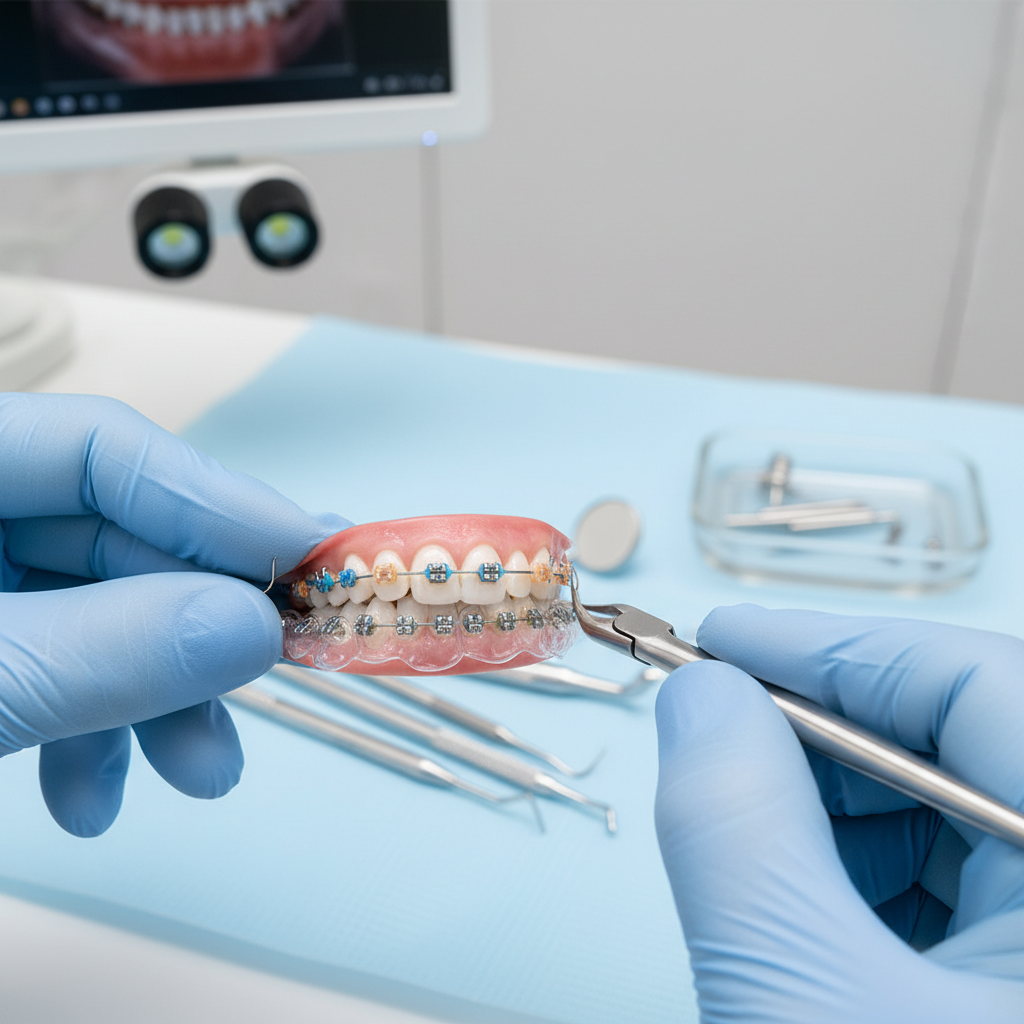
Understanding orthodontic retreatment services
If your teeth have shifted after braces or aligners, orthodontic retreatment services give you a second chance at the smile you originally hoped for. Orthodontic retreatment focuses on realigning teeth that have relapsed, refining bite problems that were never fully corrected, and upgrading older results using modern, more esthetic technology.
You might notice small changes at first, like a slight twist in a front tooth or a gap that was once closed. Over time, these shifts can affect your bite, your confidence, and even your ability to clean your teeth comfortably. Orthodontic retreatment is designed to address these concerns head on, in a targeted and efficient way, so you do not have to repeat your entire original treatment.
Orthodontic retreatment services fit especially well within a high end approach to care. You are not starting from scratch. Instead, your orthodontist builds on your previous treatment using tools like ai orthodontic planning, cosmetic orthodontic upgrades, and orthodontic finishing touches to fine tune both function and esthetics.
Why teeth shift after treatment
Teeth rarely stay frozen in place for life. Understanding why they move helps you make sense of why retreatment is sometimes necessary and why retention is so critical afterward.
Biological reasons for relapse
After your braces or aligners came off, the bone around your teeth was not fully mature. According to San Antonio Orthodontics, it can take a year or more for this bone to stabilize, and during that time your teeth are more prone to drifting [1]. In addition, the periodontal ligaments that support your teeth retain an elastic memory, which can gently pull teeth back toward their original positions.
San Antonio Orthodontics notes that orthodontic relapse can begin within weeks of removing braces and continues indefinitely without proper retention, which is why long term retainer use is now considered standard [1]. If you started with a severe bite problem or significantly rotated teeth, your natural tendency toward relapse is even stronger, so you are at higher risk of future shifting.
Lifestyle and compliance factors
Even with perfect original treatment, everyday habits influence how stable your results remain. Research from multiple practices points to inconsistent retainer wear as one of the primary causes of shifting after orthodontic treatment [2]. Life gets busy, retainers are uncomfortable or misplaced, and before you realize it, teeth have moved.
Other influences can include aging, genetics, nighttime grinding, and changing facial muscles, which is why up to 50 percent of patients experience some degree of relapse after treatment [3]. When these factors combine with lapses in retainer use, the need for orthodontic retreatment services becomes much more likely.
Signs you may need retreatment
You do not have to wait until your smile looks completely different to seek help. In fact, orthodontic retreatment is often easier, faster, and more conservative when you act early.
Common signs that you might benefit from retreatment include:
- Gaps reopening, especially between front teeth
- Crowding returning in the lower front teeth
- Teeth that look or feel slightly rotated
- Bite changes, such as new overbite, underbite, or crossbite
- Difficulty flossing between teeth that used to have space
- Edges of teeth chipping or wearing unevenly
- Jaw discomfort or changes in how your teeth meet when you bite
Dominion Orthodontics highlights that the return of gaps or crowding, along with changes in bite alignment and difficulty cleaning between teeth, are key indicators that retreatment can help [2]. If you recognize any of these issues, a focused orthodontic relapse correction evaluation can show exactly what has changed since your first treatment.
Types of orthodontic relapse
Not every relapse looks the same. Identifying the pattern of movement you are experiencing helps your orthodontist plan the most efficient retreatment approach.
San Antonio Orthodontics outlines several typical forms of relapse, including lower incisor crowding, spacing reopening, rotation relapse, and bite changes [1]. These patterns often respond well to targeted retreatment instead of full arch reconstruction.
For example, lower front crowding may be addressed with limited clear aligners or segmental braces, while an open bite or crossbite might require more comprehensive mechanics. If you fall into the category of long term or major relapse, particularly as an adult, practices like Beim Orthodontics often recommend a second round of metal braces, clear braces, or clear aligners, usually with a shorter treatment time than your first experience [3].
If your relapse is minor and relatively recent, a carefully designed new retainer may be enough to guide your teeth back, especially if only one or two teeth are affected [3]. Your orthodontist will determine where you fall along this spectrum and which retreatment tools make the most sense for you.
Modern orthodontic retreatment options
Today, orthodontic retreatment services are far more personalized and technology driven than they were even a decade ago. You have access to a full range of premium choices that can correct relapse while respecting your lifestyle, appearance, and timeline.
Clear aligners and advanced aligner systems
Clear aligners are often an ideal solution for mild to moderate relapse, especially when you want discreet treatment. Practices like Dominion Orthodontics describe clear aligners as a preferred option for minor shifts, providing predictable tooth movement with minimal impact on your daily routine [2].
In a high end setting, aligner retreatment is often supported by ai guided braces planning and digital smile planning tn. These technologies allow your orthodontist to simulate tooth movements in three dimensions, anticipate how your smile will look from every angle, and design refined movements that focus on esthetics and bite function at the same time.
Blue Wave Orthodontics notes that for many patients who stopped wearing retainers, retreatment with aligners can straighten teeth again more quickly and with less cost than full first time treatment, because the corrections are often more limited and focused [4].
Premium braces and esthetic brackets
If your relapse is more significant, braces may still provide the most efficient control. That does not mean you are limited to traditional metal. High end retreatment can include premium braces options such as ceramic or sapphire brackets, low profile systems, and esthetic bracket systems that blend more naturally with your teeth.
Dominion Orthodontics points out that ceramic and lingual braces are key choices for more complex tooth movement, especially when large corrections are required [2]. Combined with modern wires and digital planning, braces can often accomplish in a shorter time what older systems required many additional months to achieve.
In a luxury orthodontic clinic, braces based retreatment is also customized around comfort, appointment efficiency, and esthetics, so you feel like the experience reflects your standards, not just your clinical needs.
Retainer based corrections
For very small relapses, a customized retainer can sometimes act as both a holding device and an active appliance. Beim Orthodontics notes that a new retainer alone may be sufficient to correct minor crowding or spacing, and fixed retainers are often recommended for the lower front teeth in these cases [3].
Retainer based corrections are usually part of a broader refinement treatment orthodontics plan. Your orthodontist might use a series of carefully adjusted retainers or incorporate small springs and pads to nudge specific teeth into their ideal positions.
Blue Wave Orthodontics reinforces the role of retainers after retreatment, offering choices such as clear Essix retainers, Hawley retainers, and fixed retainers, along with a retainer program that ensures ongoing protection with replacement retainers as needed [4].
What makes high end retreatment different
If you are considering retreatment, you might be looking for more than a basic fix. You may want a result that finally matches your expectations for both precision and appearance, supported by technology and a more concierge level of care.
AI planning and digital smile design
Modern orthodontic technology clinic environments use tools such as 3D scanners, digital models, and AI assisted analysis to plan tooth movement with remarkable accuracy. With ai orthodontic planning, your orthodontist evaluates your current tooth positions, your original outcome, and your facial structure to create a plan that is both efficient and esthetically driven.
Digital smile planning allows you to preview your projected outcome before you even begin. This is especially valuable in retreatment, where you may be more cautious about committing again. You can see how minor adjustments, rotations, and bite refinements affect your overall smile and profile, then customize your plan to match your priorities.
Focus on finishing and detailing
Since you already invested time in orthodontic treatment once, retreatment should focus on precise detailing rather than repeating the entire journey. Practices that emphasize orthodontic technology refinements and orthodontic finishing touches pay close attention to tooth proportions, midline symmetry, smile width, and the way your upper and lower teeth contact in every position.
A 2021 study on retreatment highlighted that patients returning for a second round of care often have higher expectations and demand more efficient, excellent results. The authors recommend using objective finishing criteria, such as those of the Brazilian Board of Orthodontics, to guide retreatment so that outcomes are both stable and esthetically superior [5].
By choosing a practice that regularly manages advanced orthodontic cases, you gain access to those same high level standards for your retreatment.
Integrating cosmetic upgrades
Retreatment is an ideal opportunity to incorporate cosmetic orthodontic upgrades that were not available or chosen the first time around. You may want aligners instead of braces, more invisible bracket options, or a more expansive arch form to broaden your smile.
If you are in an area that supports orthodontic upgrades johnson city or high end orthodontics johnson city, you can pair your retreatment with enhancements like tooth contouring, whitening, or esthetic bonding coordinated with your orthodontist. Together, these choices help you move beyond simply correcting relapse and toward true smile perfection orthodontics.
Addressing complex and surgical retreatment cases
Not all retreatment is limited to small touch ups. For some patients, particularly those with long standing bite issues or facial imbalances, a more comprehensive plan that may include surgery is appropriate.
A clinical report in the Dental Press Journal of Orthodontics describes an ortho surgical retreatment for a 21 year old patient with Class II malocclusion, a gummy smile, and a retrusive chin. Treatment combined fixed appliances with maxillary impaction, mandibular advancement, rotation of the occlusal plane, genioplasty, and rhinoplasty, ultimately achieving improved facial harmony and stable occlusion four years after completion [5].
Another case in the same report followed a pre adolescent patient with severe open bite and thumb sucking. A two phase retreatment approach corrected the open bite, improved esthetics, and maintained stable results for four years, including two years without a retainer [5].
These examples highlight that when relapse is complex, a carefully staged retreatment can still deliver stable, life changing results. If your situation is more involved, a boutique practice that offers boutique orthodontic care can coordinate surgical specialists, advanced imaging, and tailored appliances to create a truly comprehensive solution.
Costs, financing, and value of retreatment
Cost is a practical part of your decision, especially when you have already paid for orthodontic care once. Understanding the financial landscape helps you plan realistically.
Typical retreatment costs and insurance
SmileWorksNYC reports that for adults, orthodontic treatment costs tend to be 20 to 25 percent higher than for younger patients, largely because adult tooth movement can be more challenging and insurance coverage is often more limited [6]. Orthodontic retreatment contributes to your total lifetime orthodontic costs in the same way.
Insurance usually covers about 50 percent of treatment up to a lifetime maximum of 1,000 to 3,000 dollars, which means you should expect significant out of pocket expenses for retreatment. SmileWorksNYC estimates that even with insurance, typical out of pocket payments range from roughly 1,638 to 4,933 dollars, and in a city like New York, uninsured costs for traditional metal braces can run from 3,000 to 7,000 dollars, while more esthetic options like ceramic or Invisalign can exceed 8,000 dollars [6].
Although these figures are location specific, they offer a framework, especially if you are comparing standard offices to luxury orthodontic clinic environments that include more advanced technology and personalized services.
Payment options and time savings
To help with affordability, many practices provide in house payment plans. SmileWorksNYC notes that these often include monthly payments without credit checks, with an initial down payment and interest free terms spread across the treatment period [6]. Blue Wave Orthodontics also offers flexible financing tailored to retreatment length, which can be shorter and therefore less costly than full treatment [4].
Because retreatment typically focuses on specific issues rather than a full arch overhaul, the total treatment time is often reduced. Practices that emphasize accelerated orthodontics johnson city may also combine high efficiency wires, adjunctive devices, or enhanced aligner protocols to shorten your timeline without sacrificing quality.
When you consider the value of improved function, esthetics, and long term confidence, especially in professional or social settings, the investment in retreatment can make sense as a final step toward the smile you always intended to maintain.
Life after retreatment and long term stability
Orthodontic retreatment services are only truly successful if your outcome stays stable over time. That is why retention planning and supportive follow up are central parts of a high end retreatment experience.
Making retention a lifelong habit
San Antonio Orthodontics emphasizes that without proper retention, relapse can continue indefinitely. The biological memory of your periodontal ligaments and the slow remodeling of bone mean that you should view retainer wear as a lifelong commitment, not a temporary phase [1].
Dominion Orthodontics also recommends wearing retainers every night, replacing worn out retainers, and maintaining regular dental checkups so that any early signs of shifting are caught and corrected quickly [2]. Programs like the retainer plan at Blue Wave Orthodontics, which offers multiple replacement retainers per year for enrolled patients, illustrate how seriously modern practices take long term protection [4].
Quality of life and confidence benefits
Beyond straighter teeth, retreatment can change how you feel day to day. The clinical cases published in the Dental Press Journal of Orthodontics showed positive effects on self esteem and oral health related quality of life, including less anxiety, easier social interactions, and better emotional well being after retreatment [5].
Patients seeking retreatment often carry disappointment from earlier experiences. The same research highlights that encouragement and positive reinforcement from your orthodontist play a crucial role in helping you commit to retreatment and feel satisfied with the final outcome [5]. When you work with a practice focused on retreatment care orthodontics and boutique orthodontic care, you gain a partner that understands the emotional side of trying again.
Choosing your path to a better smile
If you are noticing changes in your smile, you are not alone. Many adults and teens find that their teeth do not stay perfectly aligned after treatment. The difference today is that you have access to sophisticated orthodontic retreatment services that respect your time, your esthetic priorities, and your expectations for premium care.
By consulting with a provider experienced in advanced orthodontic cases, orthodontic upgrades johnson city, or high end orthodontics johnson city, you can:
- Identify exactly how and why your teeth have shifted
- Decide whether aligners, esthetic braces, or retainer based corrections are right for you
- Incorporate digital planning and cosmetic upgrades into your retreatment
- Protect your results with a realistic, long term retention plan
With the right combination of technology, expertise, and personalized attention, retreatment does not have to feel like starting over. It can be your final, decisive step toward a stable, confident, and carefully crafted smile that truly reflects who you are today.